The question of how long an end of tenancy clean takes is a bit like asking how long it takes to drive to Brighton. The honest answer is: it depends, and anyone who gives you a confident figure without asking a single question about the property is either very experienced and making a well-informed assumption, or not experienced at all and making a poorly-informed one. The variables are real and they matter – but for a three-bedroom house in Croydon they are well-understood, the ranges are predictable, and the genuine surprises are fewer than most people expect once you know what to look for.
For a standard three-bedroom house – two reception rooms, one bathroom, a kitchen, and a hallway with stairs – a professional cleaning team of two typically requires between six and nine hours to complete a full end of tenancy clean to a standard that will satisfy a professional checkout inspection. A Victorian terrace of the same bedroom count, with its period features, high ceilings, and original sash windows, sits towards the upper end of that range and occasionally beyond it. A modern new-build semi with clean lines and accessible surfaces lands closer to the lower end. Those are the headline figures. Here is what sits behind them.
Where the Time Actually Goes – A Room by Room Reality Check
The instinct most people have when estimating cleaning time is to imagine wiping down surfaces and hovering the floor, and to assume this scales relatively predictably between rooms. It does not. Different rooms carry wildly different time demands, and the distribution tends to surprise people who have not watched a professional end of tenancy clean unfold from start to finish.
In a typical three-bedroom Croydon house, the rough time allocation for a single well-equipped cleaner runs as follows. The kitchen – including the oven, extractor hood, cupboard interiors, worktops, tiles, sink, and floor – accounts for somewhere between two and three hours, depending on its size and condition. Each bathroom or shower room requires between 45 minutes and 90 minutes. Each bedroom, cleaned thoroughly to end of tenancy standard including inside wardrobes, windows, skirting boards, and floors, runs at 30 to 50 minutes per room. The hallway and staircase – one of the most chronically underestimated spaces in any terraced property – typically demands between 45 minutes and an hour and a half. Each reception room, addressed properly rather than cursorily, takes between 45 minutes and an hour. The maths adds up more quickly than most people anticipate when they are standing in the property trying to calculate whether they can manage it themselves over a weekend.
The Kitchen – The Room That Eats the Schedule
No room distorts the time estimate for a three-bedroom clean quite like the kitchen, and this is almost entirely because of the oven. A heavily soiled oven – the kind that a professional cleaner encounters in a realistic proportion of Croydon rentals – requires degreaser to be applied and left to dwell, which means the cleaner must work around it and return to it rather than completing the room in a single linear pass. Oven cleaning alone, for a thoroughly soiled appliance, accounts for 60 to 90 minutes of the kitchen total. Add the extractor hood filter, which accumulates grease at a rate that borders on impressive, and the kitchen clock ticks on.
Beyond the oven, the kitchen in a Victorian terrace in South Croydon often includes a rear single-storey extension with a larger floor area, a greater run of cupboards, and more tiled splashback surface than a compact modern kitchen. More surface area means more time, and this is one of the reasons that period properties consistently sit at the longer end of any estimate.
The Condition Factor – The Variable That Trumps Everything Else
If a single factor determines where on the six-to-nine-hour spectrum a particular clean will fall, it is the condition of the property when the team arrives. Everything else – the room count, the number of bathrooms, the presence of period features – is relatively predictable. The condition of the property is the wildcard, and it is the question every professional cleaner wants answered before committing to a specific time.
What “Lightly Soiled” and “Heavily Soiled” Actually Mean in Practice
A lightly soiled property is one where the tenants cleaned regularly throughout the tenancy and the end of tenancy clean is essentially a deep clean of a home that is already reasonably well-maintained. Limescale exists but has not calcified into something resembling a geological formation. The oven has been cleaned at some point in the past twelve months. The carpets have been vacuumed, even if not professionally treated. A lightly soiled three-bedroom house is a six-to-seven-hour job for a two-person team.
A heavily soiled property is one where the tenants’ approach to domestic cleaning can be charitably described as “hands-off.” The oven looks like the aftermath of a particularly ambitious Bonfire Night. The shower screen has accumulated enough limescale to function as a geology exhibit. There may be a mystery smell emanating from the kitchen area that will require multiple products, extended dwell times, and a degree of professional determination that borders on the philosophical. A heavily soiled three-bedroom house in Thornton Heath or Addiscombe can stretch to ten or eleven hours for the same two-person team – and a cleaner who quoted six hours without asking about the condition will arrive to an unwelcome surprise and a timeline that no longer works for anyone.
The Victorian Terrace Factor – Croydon’s Built-In Time Premium
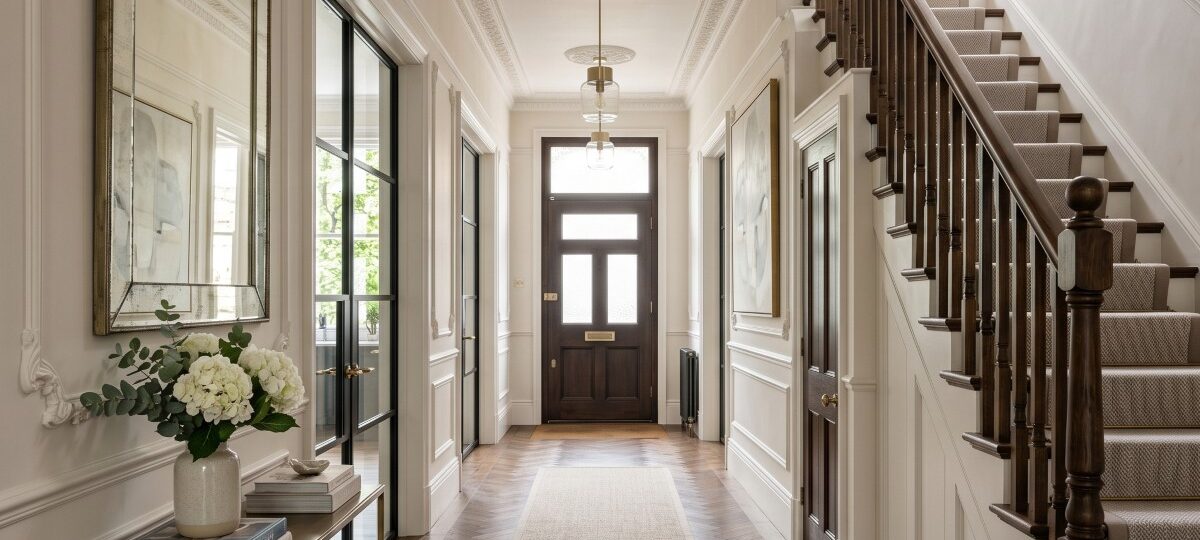
Readers of this blog will be familiar with the particular demands of Croydon’s Victorian terraced housing stock, but the time implications are worth addressing specifically in the context of a three-bedroom clean. A Victorian terrace built in the 1890s and a new-build built in 2015 share a bedroom count and very little else from a cleaning perspective.
High ceilings mean more wall surface area, more extended coving to address, and light fittings that require a proper ladder rather than an optimistic stretch. Original sash windows have sliding channels, glazing bars, and wooden frames that require more time and more specific technique than a uPVC double-glazed unit. Decorative cornicing and picture rails collect dust in their detailed surfaces in ways that a smooth modern ceiling simply does not. The staircase spindles require individual attention. Original fireplaces in the reception rooms and bedrooms – even decorative, blocked-up ones – add time that a featureless modern chimney breast does not. The under-stair cupboard, that characteristically capacious and reliably neglected space, adds its own stubborn contribution. The encaustic tiled front path needs addressing as part of the property presentation.
In practical terms, a Victorian three-bedroom terrace in South Croydon adds between 60 and 90 minutes to the total cleaning time compared with a comparable modern property in similar condition. This is not a figure that professional cleaners produce from guesswork – it reflects consistent, documented experience across a specific and very well-understood property type.
The Team Size Question – Why More Is Not Simply Faster
A natural assumption about cleaning time is that doubling the team halves the duration. In practice, the relationship between team size and completion time is considerably less linear than the arithmetic suggests, and understanding this matters when budgeting a booking.
A two-person team on a three-bedroom house can divide the property sensibly – one cleaner addresses the kitchen and ground floor while the other works through the bedrooms and bathrooms above. The workflow is logical, the rooms are sufficiently separated to avoid congestion, and the division produces genuine efficiency. A three-person team on the same property introduces coordination overhead. There are only so many rooms that can be worked simultaneously before cleaners are waiting for access or operating around each other in a narrow Victorian bathroom that was clearly designed with a single occupant in mind. Three cleaners on a three-bedroom house works well for heavily soiled properties where individual rooms genuinely require extended, simultaneous attention – but it is not three times faster than a single cleaner, and in a well-maintained property it is not always meaningfully faster than two.
The standard professional arrangement for a three-bedroom end of tenancy clean in Croydon is a two-person team booked for six to eight hours – producing twelve to sixteen combined person-hours of work, which is the appropriate resourcing for the task under most conditions.
What Professional Equipment Actually Changes About the Timing
One of the questions tenants sometimes ask when weighing up a DIY versus professional clean is whether a professional team is simply doing the same things faster, or whether something more substantive accounts for the difference. The answer is both, and the equipment dimension is significant enough to be worth understanding.
Professional-grade oven degreasers are considerably more effective than consumer products, which means shorter dwell times and less mechanical scrubbing to achieve the same result. Steam cleaners address grout lines, tiled surfaces, and fabric upholstery in a fraction of the time that manual scrubbing demands. Industrial vacuum cleaners with purpose-built attachments manage the sash window channels and decorative cornicing features of Croydon Victorian terraces in minutes rather than the improvised half-hour that a domestic machine and a collection of ill-fitting brushes requires. Professional equipment does not eliminate the time a task inherently takes – it compresses it to the genuinely irreducible minimum, which in a full three-bedroom clean makes a meaningful difference to the total on the clock.
A Realistic Timeline for a Three-Bedroom Croydon Property
Pulling all the variables together into a working estimate: a professional two-person team cleaning a three-bedroom Victorian terrace in Croydon to a full end of tenancy standard – including the oven, all windows inside and out, inside all wardrobes and cupboards, carpets vacuumed, and all period features thoroughly addressed – should be allocated seven to eight hours for a property in average condition. A lightly soiled modern equivalent runs to five and a half to six and a half hours. A heavily soiled Victorian terrace in Norbury, South Croydon, or Thornton Heath – the kind that arrives with an oven situation requiring genuine commitment and a bathroom that has not been formally introduced to a limescale remover since the previous tenancy – warrants nine to ten hours and should be booked accordingly.
The single most useful thing a tenant or landlord can do before booking is to be honest about the condition of the property. An accurate description produces an accurate time estimate, an appropriately resourced team, and a clean that passes the checkout inspection without a return visit. In Croydon’s rental market, where void periods cost money and checkout timelines leave little room for a second attempt, getting the timing right at the outset matters considerably more than most people appreciate until they have got it wrong once.