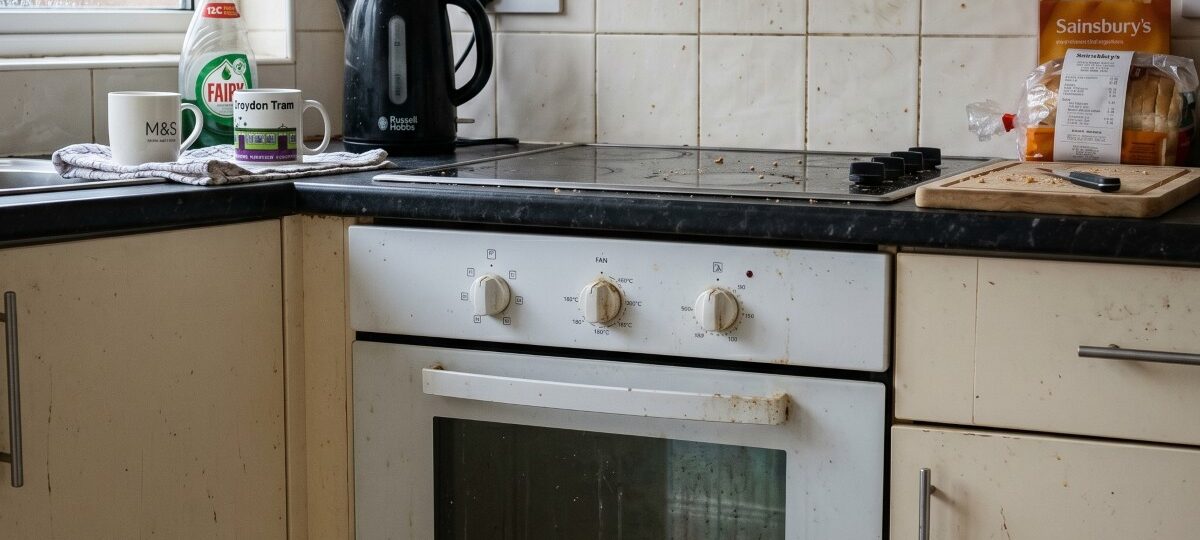
If you have ever rented a flat near East Croydon station – squeezing onto the Thameslink at 7:43am with half of South London, dreaming of the day you can afford somewhere with an actual second bedroom – you will know that the Croydon rental market does not do things by halves. Competitive rents, sharp-eyed letting agents, and landlords who have seen everything. And at the end of it all, when you are finally packing up your life into the back of a hired van and looking forward to a fresh start, one item on your checkout report has an almost supernatural ability to sour the whole affair: the oven.
Not the carpet. Not the bathroom grouting. The oven.
It is, year after year, the single most disputed item on end of tenancy checkout reports across Croydon and, frankly, across Greater London as a whole. Here is why – and what a professional clean actually means in practice.
The Checkout Report – A Document With Consequences
A checkout report is prepared at the end of a tenancy, usually by an independent inventory clerk or the letting agent themselves, and compared carefully against the original check-in inventory. The idea is straightforward: what has changed beyond fair wear and tear during your time in the property? The report is the landlord’s primary tool for justifying any deductions from your deposit, and it is treated as near-gospel by deposit protection schemes such as the Tenancy Deposit Scheme and mydeposits when disputes are referred to adjudication.
In theory, this is a sensible and fair system. In practice, the checkout report has a habit of becoming a battlefield, and nowhere is that battle fought more fiercely than in the section covering kitchen appliances. Specifically, and almost without fail, the oven.
Why the Oven Is Always the Problem
There is something almost mythological about the rental oven. You move in, it looks fine. You use it responsibly, you clean it occasionally, you do your honest best. You move out, and suddenly the checkout clerk is peering into it with the focused intensity of a forensic investigator and noting “significant grease build-up to rear interior panels and fan housing.” You protest. The letting agent shrugs. The dispute begins.
The reason ovens generate so much end of tenancy friction is a combination of factors that are, individually, entirely understandable – but together, create a perfect storm of contested cleaning. First, grease and carbon residue bake on over time and become progressively harder to shift with standard domestic products. Second, people clean the visible parts of the oven and quietly ignore the difficult ones – the fan housing, the element surround, the gap between the inner and outer door glass. Third, and most significantly, the standard required at checkout is not “looks reasonably clean” but “returned in the condition it was found.”
That phrase – returned in the condition it was found – is doing an enormous amount of work inside a tenancy agreement, and the oven is where tenants most frequently discover exactly how much.
What “Left in a Clean and Tidy Condition” Actually Means
Most tenancy agreements contain a clause requiring the property to be left in a clean and tidy condition at the end of the tenancy. It sounds reasonable enough. What it means in practice, for the oven specifically, is that the standard at checkout is matched to the condition documented in the check-in inventory. If the check-in report noted a clean oven – and in a professionally managed Croydon letting, it almost certainly did – then you are required to return it in a comparably clean state.
This is precisely where the gap opens between what a tenant considers “clean” and what an inventory clerk records as “clean.” The former involves a can of oven spray and a determined hour on a Sunday afternoon. The latter involves a standard that professional oven cleaners train specifically to meet. They are not, it turns out, the same thing.
The Croydon Rental Market and the Deposit Dispute Landscape
Croydon has one of the highest concentrations of private rented properties in outer London, particularly across areas like Thornton Heath, Norbury, Addiscombe, and South Croydon. The borough has seen sustained investment and regeneration in recent years – the continuing development around the town centre and the enduring appeal of East Croydon as one of the best-connected commuter stations in the capital have collectively kept demand for rental properties consistently high.
High demand means competitive rents. Competitive rents mean higher deposits. And higher deposits mean considerably more at stake when a checkout report lands in your inbox with a list of proposed deductions. Across the Croydon area, end of tenancy cleaning disputes – and oven cleaning disputes in particular – are among the most common reasons that deposit cases are referred to formal adjudication. The adjudicators apply a simple test: was the item returned in the condition recorded at check-in? The burden of proof falls on the landlord to demonstrate it was not, and on the tenant to demonstrate that it was.
A professional oven cleaning receipt is one of the strongest pieces of evidence a tenant can produce. It does not just show that cleaning was attempted – it shows that it was completed to a recognised professional standard.
What Professional Oven Cleaning Actually Involves
A professional oven clean is a considerably more involved process than the domestic version, and understanding the difference is genuinely useful when weighing up whether to attempt it yourself or bring in a specialist.
Professional oven cleaners use a caustic dip-tank system for removable components – racks, trays, side runners, and door glass panels are fully immersed in a heated chemical bath that dissolves baked-on carbon and grease without abrasive scrubbing. The oven interior is treated with professional-grade, non-caustic cleaning solutions that are left to dwell, then carefully removed, leaving no chemical residue. The fan housing, the element surround, and the back panel – the areas most consistently missed in a DIY clean – are addressed as standard.
The Parts Most DIY Cleaners Miss
The honest truth about most DIY oven cleans is that they tackle the obvious surfaces and leave the rest. The fan at the back of a fan-assisted oven accumulates a ring of baked grease around its housing that is almost invisible until you look for it – and inventory clerks do look for it. The gap between the inner and outer door panels traps spattered grease with impressive efficiency and is genuinely difficult to access without removing the door, which most tenants understandably do not attempt. The rubber door seal collects residue around its entire circumference. The element, where accessible, develops a coating of burnt-on deposits over time that no supermarket foam spray was designed to address.
These are the details that separate a professionally cleaned oven from a domestically cleaned one, and they are precisely the details that experienced checkout clerks across Croydon have been trained to inspect.
The Financial Arithmetic of Deposit Deductions in Croydon
Croydon rents vary significantly by area, but a reasonable average for a two-bedroom flat in South Croydon or Addiscombe currently sits somewhere in the region of £1,400 to £1,800 per month. At five weeks’ rent – the standard deposit cap under the Tenant Fees Act 2019 – a tenant in that bracket is holding somewhere between £1,615 and £2,077 in a deposit protection scheme.
A professional oven clean for a standard domestic oven in the Greater London area costs in the region of £60 to £100, depending on the oven type and its condition. A single oven deduction on a Croydon checkout report, by contrast, commonly ranges from £80 to £150 – and that is before any additional charges for racks, trays, or the extractor hood. The arithmetic is not complicated. The professional clean is almost always the more economical option, even before you factor in the time, the effort, and the cost of the cleaning products required to attempt it yourself.
Evidence, Receipts, and Protecting Yourself
Deposit protection schemes are notably receptive to documentary evidence, and a dated professional cleaning receipt is among the most straightforward forms of it to produce. It demonstrates that the property received a professional standard of end of tenancy cleaning, establishes a clear timeline relative to the checkout date, and shifts the evidential burden in any dispute firmly back towards the landlord.
If you are moving out of a property in Croydon – whether it is a purpose-built flat near George Street, a Victorian terrace in Purley, or a conversion in Norbury – having that receipt on file alongside photographs taken immediately after the clean is the most effective practical protection available to you, short of attending the checkout inspection in person. In many cases, the two together make a deposit dispute simply not worth pursuing from the landlord’s perspective.
The Standard That Ends the Argument
The phrase that appears most often in successful deposit dispute resolutions is “returned to a professionally clean condition.” It is the threshold that letting agents reference, that inventory clerks apply, and that adjudicators use as their benchmark. An oven that has been professionally cleaned meets that threshold by definition. An oven that has been vigorously scrubbed on moving day, with the best of intentions and a market-leading foam spray, may or may not – and the uncertainty is precisely where deposit deductions live.
In Croydon’s busy, professionally managed rental market, removing that uncertainty is not a luxury. It is just good tenancy housekeeping.