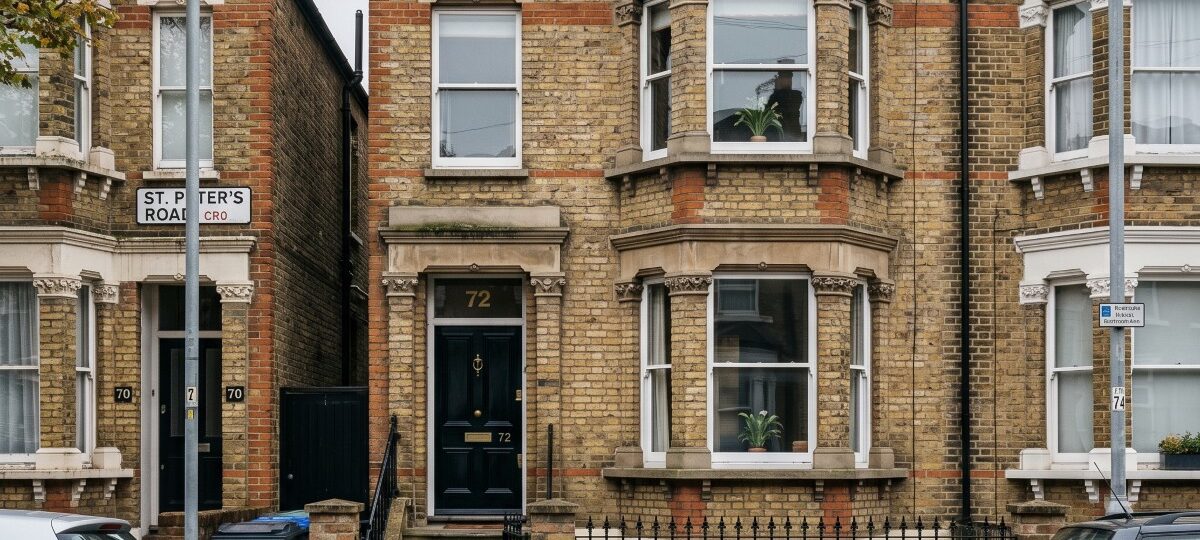
Croydon’s Victorian terraced houses have a personality of their own. They line the streets of South Croydon, Norbury, and Addiscombe with a quiet confidence – bay windows catching the morning light, original coving intact above the picture rail, encaustic tiles on the front path worn smooth by a century of footsteps. They are genuinely beautiful properties to live in. They are also, as anyone who has ever attempted to clean one at the end of a tenancy will readily confirm, a rather special kind of challenge.
A Victorian terrace is not a new-build. It does not have smooth plasterboard walls, easy-clean surfaces, and uniformly accessible corners. It has character – and character, in cleaning terms, means original features that collect dust in places no modern hoover attachment was designed to reach, sash windows with channels accumulating grime since before your grandparents were born, and fireplaces that have not seen a flame in decades but have been quietly gathering atmospheric London soot regardless. This is the professional checklist for cleaning one properly.
Why Victorian Terraces Demand a Different Approach
The standard end of tenancy checklist – the one that works perfectly well for a 1990s semi or a modern flat near East Croydon station – is not entirely sufficient for a Victorian terrace. The architecture creates specific challenges that simply do not exist in newer properties, and a letting agent or inventory clerk who knows their Croydon stock well will inspect accordingly.
High ceilings mean more wall surface area, more coving and cornice to accumulate dust, and light fittings that require an actual ladder rather than optimistic tiptoe-stretching. Original skirting boards – often 20cm or taller in a period property – have more surface area, more painted detail, and more tendency to retain furniture scuffs. Sash windows have sliding channels, glazing bars, and draught strips that collect grime in their own specific ways. Original floorboards have gaps that a vacuum cleaner alone will not adequately address. None of this is insurmountable. It simply requires a more methodical approach than a developer-finish flat demands.
The Entrance Hallway and Front Path
First impressions carry disproportionate weight in checkout inspections, and in a Croydon Victorian terrace the entrance makes its statement before anyone has opened the front door. The encaustic tiled path – that geometric mosaic of black, white, and terracotta that is one of the defining visual signatures of South London Victorian housing – needs to be swept, scrubbed, and cleared of moss or weed growth between the tiles. A stiff brush and appropriate tile cleaner will address the surface; the grout lines require a narrower brush and patience.
Inside, the hallway sets the tone for the entire inspection. This means attention to: the coving where the ceiling meets the wall, the picture rail if present, the full height of the skirting boards, any dado rail, the front door on both sides including the letterbox, the door furniture, and any stained or leaded glass panels – which require a careful clean rather than an enthusiastic one.
The Staircase – A Victorian Terrace’s Most Demanding Feature
The staircase in a Victorian terrace is not simply a set of steps. Each tread has a front edge, a top surface, a back riser, and two side sections where it meets the spindles. The spindles themselves – often turned wood, often painted, often bearing the accumulated evidence of years of hands gripping them at pace – need to be wiped individually. The underside of the handrail collects dust in a manner that borders on impressive. If the stairs are bare floorboard, the gaps between the boards need attention with a fine brush or a narrow vacuum attachment. This is not a small task. Plan for it accordingly.
The Reception Rooms
Victorian terraces in Croydon typically offer two reception rooms – a front room with a bay window and a back reception opening towards the kitchen or garden. Both require the same methodical treatment, top to bottom: ceiling rose if present, coving along all four walls, picture rail, walls, dado rail if fitted, window reveals, skirting boards, fireplace, and then floor. The bay window in the front reception deserves specific attention – the window boards and the interior of the bay are frequently forgotten, and the three-pane configuration means three sets of windows, three sets of frames, and three sill surfaces both inside and out.
Original Fireplaces – Decorative or Working, Both Need Attention
Most Victorian terraces in Croydon still have their original fireplace openings in the reception rooms, even where they were blocked up sometime in the 1970s by someone whose enthusiasm for gas central heating outweighed their appreciation of period character. Decorative fireplaces accumulate dust in the mantelpiece detailing, the tiled surround, and the grate or blocked opening. Working fireplaces accumulate all of that, plus the residue of actual use.
Either way, the fireplace is on the checkout report. The mantelpiece surface, the tile surround, the hearth tiles, the grate, and the interior of the opening where accessible all need to be cleaned. Cast iron features respond well to a dedicated cast iron cleaner or very fine wire wool, applied carefully and with the grain.
The Kitchen
Many of Croydon’s Victorian terraces have had their kitchens extended at some point – a single-storey rear addition that replaced the original scullery, creating a room that is frequently part-Victorian, part-modern extension, with a correspondingly mixed range of surfaces to address.
The oven remains – as it invariably does, and as we have discussed at some length in these pages – the central challenge. Beyond it, the checklist runs: extractor hood and filter, hob and surrounding surfaces, splashback tiles including grout lines, worktops and upstands, the underside of wall-mounted cupboards, the interior of all base and wall units, the sink and taps, and the floor including the junction between floor and skirting board where grease accumulates undisturbed for years.
The Under-Stair Cupboard – The Bermuda Triangle of Victorian Terraces
The under-stair cupboard deserves a specific mention because it is present in virtually every Victorian terrace in Croydon and consistently receives the least rigorous cleaning of any space in the property. Things go into the under-stair cupboard and do not come out. The inventory clerk is aware of this tendency. The space needs to be fully emptied, vacuumed including the angled ceiling and awkward rear corners, wiped down, and left with the door open at inspection so that its emptiness can be visually confirmed without ambiguity.
The Bathrooms
Victorian terraces were not built with indoor bathrooms – they were retrofitted later, which means that in many of Croydon’s period rental properties the bathroom occupies what was originally a bedroom, usually at the first-floor rear. It is often a larger space than a modern bathroom, which is agreeable to use and more work to clean.
The checklist covers: bath or shower including taps, screen or curtain rail, and overflow; WC including the cistern top, flush housing, underside of the rim, and floor around and behind the pedestal; sink and taps; mirror and cabinet; towel rail; and window. Sash windows in bathrooms are particularly prone to mould on the wooden frame and sill due to condensation – treat these with a dedicated mould remover rather than a standard surface cleaner, and allow it proper dwell time. Tiled surfaces, grout, and floor complete the room. London hard water leaves its signature everywhere in a Victorian terrace bathroom, and the limescale on taps, shower heads, and chrome surfaces demands an acid-based remover and genuine patience.
The Bedrooms
Bedrooms in a Victorian terrace follow the same top-to-bottom principle as every other room, but with specific attention paid to the period features that a modern property simply does not carry. Coving and picture rails collect dust year-round and are routinely skipped in a basic clean. Sash windows need the sill, frame, sliding channels, and glazing bars all addressed as separate elements. Built-in Victorian cupboards – characteristically fitted either side of the chimney breast – need their shelves, walls, and floors cleaned inside, and their doors and door furniture cleaned outside.
The chimney breast itself, even where the fireplace has been removed and the opening plastered over, is a focal point of the room. Its surfaces should be clean and free of marks, and where the original cast iron fireplace is intact, it receives the same treatment as the reception room versions.
The Garden and External Areas
The rear garden or yard is part of the tenancy and part of the checkout report without exception. The checklist here covers sweeping paths and patios, removing all personal items including anything stored in a bin area or coal bunker, clearing weed growth from between paving slabs, cutting the lawn where one exists, and ensuring the rear gate is clean and operable. Bin areas are inspected, are frequently forgotten by tenants, and can harbour a quietly remarkable accumulation of residue over the course of a tenancy.
Original Features and the Professional Standard
The aspect of cleaning a Croydon Victorian terrace that catches most tenants unprepared is not the sheer volume of work – it is the standard against which original features are assessed. A modern kitchen can be wiped to a uniform shine with reasonable confidence. Original coving with its plaster detailing, period skirting boards with their layers of accumulated paint, and encaustic tiles with their porous surfaces and aged grout all require specific techniques, appropriate products, and a clear-eyed understanding of what “clean” actually means for a material installed during the reign of Queen Victoria.
The principle remains constant throughout: the property must be returned in the condition in which it was found. For a Croydon Victorian terrace, that condition was documented in an inventory that noted original features, period details, and the particular character of the address. Meeting that standard – fully, methodically, and in the correct order – is the task in its entirety.